

 Januari 29, 2011
 princeroddyfiacreparris
Free PDF Basic Income: A Radical Proposal for a Free Society and a Sane Economy
Program your excellent activity to earn your life look better. Wait, not only look much better however exactly great sufficient! Are you assuming that many individuals will be so admired of you that have excellent habits? Obviously it can be one of the benefits that you could obtain when having that type of hobbies. And now, exactly what about reading? Is his your hobby? Well, checking out book is boring, will you believe that so? Really, that's not.
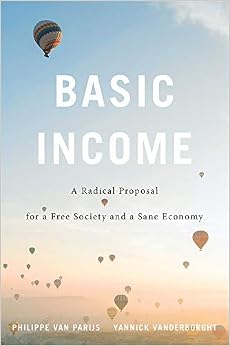
Basic Income: A Radical Proposal for a Free Society and a Sane Economy

Free PDF Basic Income: A Radical Proposal for a Free Society and a Sane Economy
Reserve, real pal of your own while remaining in a lonesome time. Book, is a friend for you to go along with when remaining in a hard time of task deadline. Book is a way that you have to hold daily making far better future. When a person is resulting in obtain several tasks and also you have couple of times openly, it will be much better for you to invest it carefully.
Do you still have no idea with this book? Why needs to Basic Income: A Radical Proposal For A Free Society And A Sane Economy that ends up being the ideas? Everybody has different issue in the life. But, related to the valid educational and also understanding, they will certainly have very same verdicts, of course based on facts and also research. As well as currently, exactly how the Basic Income: A Radical Proposal For A Free Society And A Sane Economy will provide the presentation regarding just what facts to constantly be mind will certainly influent just how some individuals assume and bear in mind regarding that trouble.
This Basic Income: A Radical Proposal For A Free Society And A Sane Economy belongs to the soft file book that we provide in this on-line website. You may find this kind of books and other collective books in this website actually. By clicking the link that we offer, you can go to the book site and enjoy it. Saving the soft file of this book becomes what you can overcome to read it everywhere. This way can evoke the break boredom that you can feel. It will also be a good way to save the file in the gadget or tablet, so you can read it any time.
Additionally, when you have the analysis behavior, it will certainly lead you to keep as well as move forward for far better problem. A book as one of the windows to reach better globe can be accomplished by positioning the expertise. Even you have no suggestions concerning guide formerly, you could comprehend a growing number of after starting from the first page. So, what do you think of Basic Income: A Radical Proposal For A Free Society And A Sane Economy that you can take it to check out from currently?
Review
“A meticulously comprehensive, frequently persuasive accounting of [universal basic income’s] superiority by measures economic, philosophical, and pragmatic.â€â€•Nathan Heller, New Yorker“Basic Income provides a rigorous analysis of the many arguments for and against a universal basic income, offering a road map for future researchers who wish to examine policy alternatives.â€â€•Marc Levinson, Wall Street Journal“Although their goal is utopian, Van Parijs and Vanderborght aim to infuse it with economic and political realism…What Van Parijs and Vanderborght bring to this topic is a deep understanding, an enduring passion, and a disarming optimism.â€â€•Steven Pearlstein, Washington Post“Van Parijs and Vanderborght go deep, focusing exclusively on a universal guaranteed income and examining a range of philosophical, practical and political arguments for and against it. In considered, often enlightening, prose, they delve into John Rawls, Ronald Dworkin and Amartya Sen. They look at a number of alternative schemes; they discuss various objections to guaranteed income programs, including those over cost, free riding, and the possibility of diminished incentives.â€â€•Akash Kapur, Financial Times“Van Parijs and Vanderborght have done the discussion of a universal basic income a great service. They have set forth, clearly and comprehensively, what is probably the best case to be made today for this form of economic and social policy.â€â€•Benjamin M. Friedman, New York Review of Books“What matters―what will lift the heart of every reader of Basic Income―is that Van Parijs and Vanderborght have enlisted the rigor and scruple of first-rate social science in the service of a generous social vision that is at least as old as Saint Ambrose and as up-to-date as Pope Francis. Our sensible and humane descendants―they are bound to be sensible or humane, since humanity would otherwise have long since succumbed to nuclear or environmental catastrophe―will doubtless wonder, with the easy impatience of posterity, what we were waiting for. They may, in fairness to us, decide that we were waiting for books like this.â€â€•George Scialabba, Commonweal“Provid[es] argument after argument as to why [basic income’s] introduction would be ‘economically clever’ and why it is the next logical step to take in a long history of social policies aimed at reducing poverty and inequality. Their proposals are not only clear but also extremely pragmatic…The value of this book is that, more comprehensively than any other study yet, it explains why an obligation-free income for all would be so beneficial, and it also charts how this could be incrementally attained.â€â€•Danny Dorling, Times Higher Education“The book is likely to become a primer on core debates, such as the scheme’s overall feasibility, but its most striking aspect is how the authors make their argument. They justify a basic income not as a tool with which to address inequality, but rather as an ‘instrument of freedom.’â€â€•Aaron Reeves, Nature“Will be essential for the ongoing debate.â€â€•Ben Collyer, New Scientist“The West is awash these days in populist movements that cloak repressive and inegalitarian agendas. In these troubled times, an unconditional basic income is a beacon: a workable proposal that furthers freedom and equality for all. In this book, two modern pioneers of the UBI make the moral and practical case for endowing everyone with the resources to shape a life of their own choosing.â€â€•Anne Alstott, Yale University
Read more
About the Author
Philippe Van Parijs is Professor of Economic and Social Ethics, University of Louvain. Yannick Vanderborght is Professor of Political Science, Université Saint-Louis, Brussels.
Read more
Product details
Paperback: 400 pages
Publisher: Harvard University Press; Reprint edition (April 22, 2019)
Language: English
ISBN-10: 0674237463
ISBN-13: 978-0674237469
Product Dimensions:
6 x 1.2 x 9.2 inches
Shipping Weight: 15.7 ounces (View shipping rates and policies)
Average Customer Review:
3.3 out of 5 stars
9 customer reviews
Amazon Best Sellers Rank:
#484,312 in Books (See Top 100 in Books)
The author makes a compelling case for basic income and then, thoroughly and realistically, explains why it will be so hard to achieve. The potential for unleashing creative energy is intriguing. The outcome of the Finnish trial should be very interesting.
The authors present the pros and cons of basic income as it relates to political, economic, and social morals. They offer substantial plans for funding basic income. A well thought out book.
This book is very detailed but too academic for most readers.
The authors thoroughly review the pros and cons of a basic income. It is an important contribution to an intelligent debate on a social innovation that can contribute to the sustainability of the European welfare states - and elsewhere.
Not something I could buy into based on​ this book, but radical thinking is what is needed in the constant evolution of our society.
This is the most extensive discussion available on the subject of egalitarian justice, covering ethics, human behaviorism, politics, economics and history of public assistance. In contrast to the usual egalitarian diatribe, this one is well written, well researched and well argued.V&V profess a liberal-egalitarian approach while citing communist, libertarian, and capitalist justifications of a public provided basic income. There is discussion of alternatives, social insurance and negative income tax to the point where the later seems preferable to the advocated program. In practical considerations, inflation is dismissed as a minor risk, while negative motivations are extensively analyzed.For economical justification they dismisses risk of inflation as minor, There is a more realistic discussion of negative incentives. It's all based on ethics rather than economics. The ethics discussion is largely based on Karl Marx. It was Robespierre who suggested that man has a right to exist. Malthus disclaimed right to assistance as deteriorating condition of poor and rich. Locke wrote on poor laws, while Bertrand Russel proposed a SMALL certain income. Relying on the socialist economics of Thomas Piketty and Paul Krugman, they torture the utilitarian logic of Jeremy Bentham, the ethical analysis of John Rawls, the economics of J.M. Keynes and the philosophy of Frederick Hayek. They never incorporate the most pertinent economist, Wilfred Pareto. More modern is the failure of Lula da Silva's “zero hunger†policy.In pointing out the negatives, BI universality contributes to its political resilience.Rather than the usual arithmetically unfeasible tax the rich schemes, they admit to the need to tax high on rates densely populated.The authors never say what happens to current welfare programming. Whatever the merits of a guaranteed income as a replacement for current Social Security and Great Society programming, as an add on on it would be a disaster.
This is a comprehensive and therefore welcome exposition of many aspects of the basic income proposal, including its justifications, implications, history, philosophy, economics and politics. The philosophies and arguments of Rawls, Dworkin, Sen, Keynes and Marx are all rehearsed. This extensive coverage makes the book rather longwinded, occasionally rambling and repetitive, a stream of academic consciousness with frequent diversions.There is no doubt of the appeal of basic income which van Parijs and Vanderborght present well. The problem lies in two main objections – supposed work disincentive, and macroeconomic cost. The authors’ response to the free-rider problem, that others already free-ride, or yet others work without remuneration, is hardly convincing, particularly since a forthcoming paper by Richard McGahey in Ocampo and Stiglitz ‘The Welfare State and Inequality’ (Columbia University Press) cites extensive evidence of the work dis-incentivisation of basic income.Admitting that localised externally funded basic income experiments do not demonstrate basic income affordability, and dismissing a range of alternative mechanisms to fund BI, the authors scale back to proposing a ‘partial basic income’ funded by income tax which they define only vaguely and do not cost (pp 165-169), but then immediately claim that a basic income of 25% of GDP per capita is affordable (p170)!Equally unjustified is their summary rejection of the case for basic income from Keynesian demand deficiency in high technology economies (p130), and its funding by money creation (p152). ‘Helicopter money’ they say, ‘can only be of limited duration’. They are limited by their adherence to financial orthodoxy which will never show basic income affordable. They incorrectly interpret the Keynesian demand argument to rely on economic growth, whereas the argument is growth neutral and applies to constant or even reduced GDP. In this casual dismissal, they reject a powerful objective argument for basic income and its funding.In a thought experiment where a machine is plugged into the earth to produce all GDP output without any labour, and this GDP is distributed by vouchers issued and destroyed each year, then it follows that 100% of GDP becomes basic income, and 100% of GDP is deficit financed. The nuanced claim is that in high tech economies where output increasingly exceeds wage, then basic income is essential and financial deficit inevitable. Recent economic fact supports both these hypotheses. Though radical, this thesis is credible, has huge power as an argument for deficit funded basic income, and is one which the authors should examine further.
The title is oxymoronic. With any type of intervention in the labor market whether it be minimum wage, minimum living waste or the garbage presented in this book, society is NOT free!
Basic Income: A Radical Proposal for a Free Society and a Sane Economy PDF
Basic Income: A Radical Proposal for a Free Society and a Sane Economy EPub
Basic Income: A Radical Proposal for a Free Society and a Sane Economy Doc
Basic Income: A Radical Proposal for a Free Society and a Sane Economy iBooks
Basic Income: A Radical Proposal for a Free Society and a Sane Economy rtf
Basic Income: A Radical Proposal for a Free Society and a Sane Economy Mobipocket
Basic Income: A Radical Proposal for a Free Society and a Sane Economy Kindle


