

 Februari 11, 2010
 princeroddyfiacreparris
Get Free Ebook Functional Thinking: Paradigm Over Syntax
Functional Thinking: Paradigm Over Syntax. Eventually, you will discover a brand-new journey as well as knowledge by investing even more cash. However when? Do you believe that you have to acquire those all demands when having significantly cash? Why don't you attempt to get something simple initially? That's something that will lead you to know even more concerning the world, experience, some locations, past history, amusement, and also more? It is your very own time to continue checking out routine. One of the publications you can take pleasure in now is Functional Thinking: Paradigm Over Syntax right here.
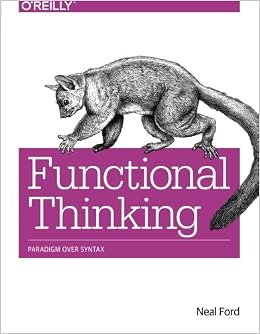
Functional Thinking: Paradigm Over Syntax

Get Free Ebook Functional Thinking: Paradigm Over Syntax
Ultimate book collections can be obtained if you always visit this web page. Discover the million of publications here. All categories from many resources, authors, as well as writers around the globe are presented. We not just provide guide collections from within this country. Several accumulated books are from the outsiders. However, the aims are very same. They are offered as a united library by on-line to offer even more valuable resources to get guide.
After getting such info from us about this publication what should you do? Once again, this is an appropriate publication that is created specifically for you, the person that enjoys reading a lot. You are the viewers with big curiosity as well as you will not quit of a book. Functional Thinking: Paradigm Over Syntax truly what you need now. You may not be weird with this title of guide, may not you? It is not the moment that you will certainly surrender to complete. You can finish it each time you desire.
Obtaining the competed web content of the book even in the soft file is truly amazing. You could see how the Functional Thinking: Paradigm Over Syntax exists. Prior to you get the book, you could unknown concerning just what the book is. However, for even more feasible thing, we will certainly share you little bit about this book. This is the book to suggest that provides you an advantage to do. It is also offered in very fascinating reference, example, as well as explanation.
You could conserve the soft data of this publication Functional Thinking: Paradigm Over Syntax It will certainly depend on your extra time and also activities to open and also read this publication Functional Thinking: Paradigm Over Syntax soft documents. So, you may not hesitate to bring this publication Functional Thinking: Paradigm Over Syntax all over you go. Merely add this sot data to your kitchen appliance or computer disk to permit you review whenever and all over you have time.
Book Description
Paradigm Over Syntax
Read more
About the Author
Neal is Director, Software Architect, and Meme Wrangler at ThoughtWorks, a global IT consultancy with an exclusive focus on end-to-end software development and delivery. Before joining ThoughtWorks, Neal was the Chief Technology Officer at The DSW Group, Ltd., a nationally recognized training and development firm.Neal has a degree in Computer Science from Georgia State University specializing in languages and compilers and a minor in mathematics specializing in statistical analysis. He is also the designer and developer of applications, instructional materials, magazine articles, and video presentations. He is also the author of 6 books, including the most recent Presentation Patterns and Functional Thinking. Given his degree, Neal is a bit of a language geek, with affections including but not limited to Ruby, Clojure, Java, Groovy, JavaScript, Scala and C#/.NET. His primary consulting focus is the design and construction of large-scale enterprise applications. Neal is an internationally acclaimed speaker, having spoken at over 300 developer conferences worldwide, delivering more than 2000 presentations. If you have an insatiable curiosity about Neal, visit his web site at nealford.com. He welcomes feedback and can be reached at nford@thoughtworks.com.
Read more
Product details
Paperback: 180 pages
Publisher: O'Reilly Media; 1 edition (July 20, 2014)
Language: English
ISBN-10: 1449365515
ISBN-13: 978-1449365516
Product Dimensions:
7 x 0.4 x 9 inches
Shipping Weight: 12 ounces (View shipping rates and policies)
Average Customer Review:
3.7 out of 5 stars
10 customer reviews
Amazon Best Sellers Rank:
#312,611 in Books (See Top 100 in Books)
I really enjoyed this book. I found it useful to learn the concepts first, then see various implementations of the concepts in different languages.
great book for those who would like to start writing functional programs
Astoundingly good at getting across functional ideas!
Nice explanation of changing your mindset, not teaching syntax.
Good general coverage of functional concepts in a clear way.
I think this may be my first amazon review, but I had to respond after seeing two very negative reviews about this book. First, I can understand that this book can be confusing, as it dives right in to functional programming (FP) without a primer or appendix to help beginners. (I strongly recommend [defmacro - Functional Programming For The Rest of Us](http://www.defmacro.org/ramblings/fp.html) for that purpose.) However, as an intermediate developer with an (apparently) above-average exposure to FP, I found this book to be extremely illuminating and incredibly useful for me to advance to the next level of FP understanding.Sidenote: One reviewer asserts that the author is confused and perhaps lacks knowledge. I don't know Neal Ford, but I am very familiar with the output of the company at which he works - ThoughtWorks. I can say for certain that anyone employed by them for years is certainly knowledgeable about software engineering, particularly when it comes to real-world usage.Why did I find the book so valuable?* As you can see from the [hosted code](https://github.com/oreillymedia/functional_thinking), Ford accompanies all of his code examples with unit tests, which I find essential for understanding and trust.* Most examples are done in Clojure (a LISP variant for the JVM), Groovy (a dynamic JVM language), **and** Java 8 (sometimes using the Functional Java library), as well as a number in Scala. I find that comparisons between languages improve my learning and retention, in addition to giving extra perspective.* Ford guides the reader through the mix of terminology for the essential FP functions and how they differ by language: map (when it is called 'collect' and why; a.k.a select), reduce (when it is called 'collect'; plus how it differs from fold), and filter (a.k.a. where).* All concepts are followed by (or introduced with) example code - this is not just a theory book.* Some Design Patterns are reviewed and translated to their FP equivalents, which are often simpler.* He provides the best explanation of recursion I've ever read:"In reality, [recursion is] a computer-sciencey way to iterate over things by calling the same method from itself, reducing the collection each time, and always carefully ensuring you have an exit condition. Many times, recursion leads to easy-to-understand code because the core of your problem is the need to do the same thing over and over to a diminishing list."* Ford also provides a helpful explanation of Currying vs partial application (better in context, but here is the crux):"Currying describes the conversion of a multi-argument function into a chain of single-argument functions. It describes the transformation process, not the invocation of the converted function. The caller can decide how many arguments to apply, thereby creating a derived function with that smaller number of arguments. Partial application describes the conversion of a multi-argument function into one that accepts fewer arguments, with values for the elided arguments supplied in advance. The technique’s name is apt: it partially applies some arguments to a function, returning a function with a signature that consists of the remaining arguments. With both currying and partial application, you supply argument values and return a function that’s invokable with the missing arguments. But currying a function returns the next function in the chain, whereas partial application binds argument values to values that you supply during the operation, producing a function with a smaller arity (number of arguments). This distinction becomes clearer when you consider functions with arity greater than two. For example, the fully curried version of the process(x, y, z) function is process(x)(y)(z)"There were times that I skimmed through sections (particularly the ones heavy on a Java implementation of pattern matching), but overall I was extremely pleased with the content.
Amazing deal for an excellent book
Pretty bad. Full of errors. Doesn't go in depth for almost anything. Extremely basic and does not go at all into what functional programming is. Avoid this book.
Functional Thinking: Paradigm Over Syntax PDF
Functional Thinking: Paradigm Over Syntax EPub
Functional Thinking: Paradigm Over Syntax Doc
Functional Thinking: Paradigm Over Syntax iBooks
Functional Thinking: Paradigm Over Syntax rtf
Functional Thinking: Paradigm Over Syntax Mobipocket
Functional Thinking: Paradigm Over Syntax Kindle


0 komentar:
Posting Komentar